Khan el Khalili bazaar is the one stop in Cairo where getting lost is the point
Khan el Khalili bazaar is the one stop in Cairo where getting lost is the point
Khan el Khalili bazaar is the medieval market at the heart of Islamic Cairo, a tangle of covered lanes that grew out of a caravan inn built in the 1380s and has never stopped trading. Goldsmiths keep to one lane, spice and perfume sellers to another, coppersmiths and lantern makers to the workshops behind them, and the old El Fishawi coffeehouse sits in the middle of it all. Go in the late afternoon, when the heat drops and the lamps come on, treat haggling as a game with rules, drink your tea slowly, and walk out through Al Muizz street. Below: the layout, what to buy, what to skip, and how we fit it into an Islamic Cairo day.
How a 14th-century caravan inn became the market of Cairo
A khan is a caravanserai, a walled inn with a courtyard where merchants parked their camels, slept upstairs and traded on the ground floor. In 1382 a Mamluk emir named Jaharkas al Khalili, master of the stables under Sultan Barquq, built one here on the site of the old Fatimid royal tombs, on the commercial spine of the city. His name stuck to the inn, then to everything around it.
About a century later Sultan al Ghuri rebuilt the quarter on a grander plan, with stone gates, arcaded lanes and a covered market hall. Two of his Mamluk gateways still stand in the Badestan lane, the oldest and most photogenic stretch of the bazaar.
This was never a market built for tourists. It was the wholesale district of a trading capital between the Red Sea and the Mediterranean, and its guild logic still shapes it. Each trade clustered in its own lane so buyers could compare, which is why the goldsmiths are still together, the spice sellers are still together, and the copper workshops still hammer within earshot of each other.
The layout, lane by lane
The bazaar has no gate and no map you can trust, but it does have a logic. Picture a rough triangle: Al Azhar street along the south edge, Al Muizz street up the west edge, and Al Hussein square with its mosque on the east. The lanes inside connect all three.
- The goldsmiths' lane, Al Sagha. Off Al Muizz on the western side. Tiny shops with glass counters and precision scales, gold sold by weight plus workmanship. Cartouche pendants with your name in hieroglyphs are made here, at a far more honest price than in the tourist strip.
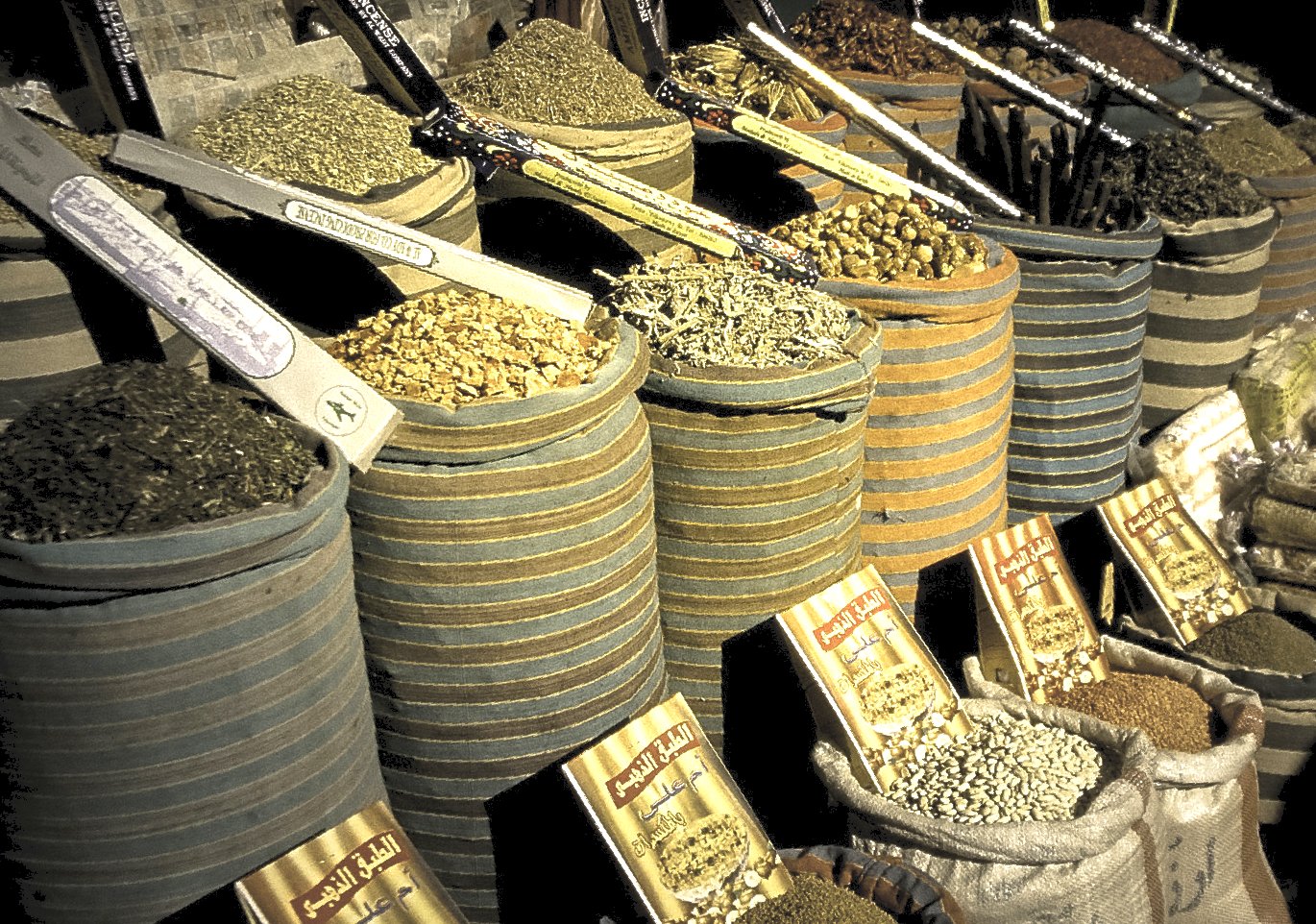
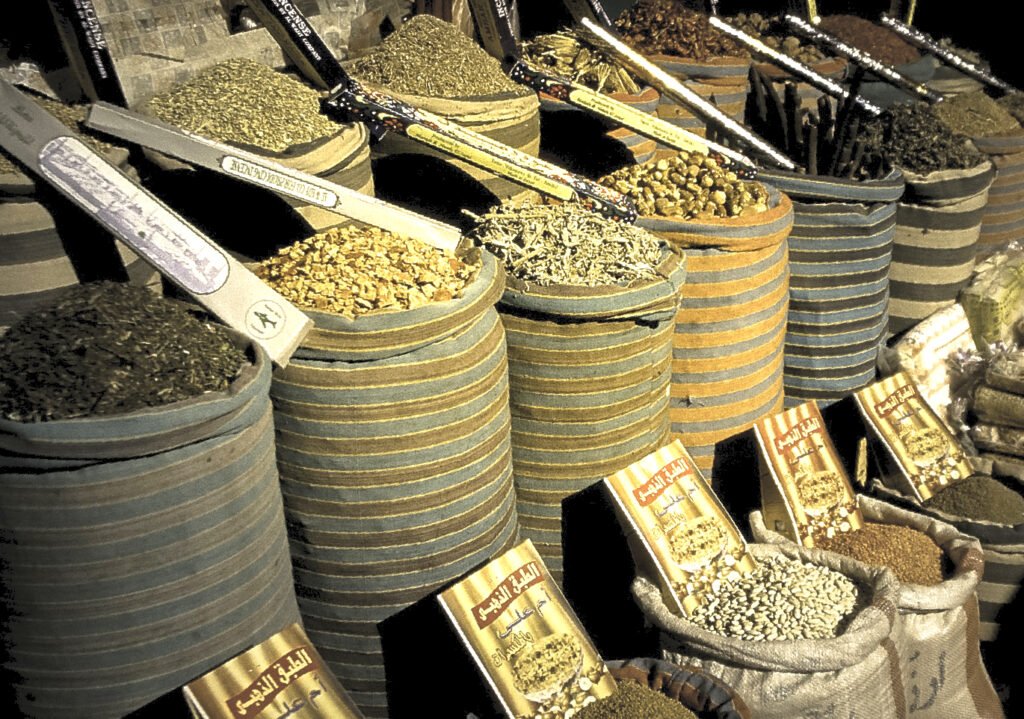
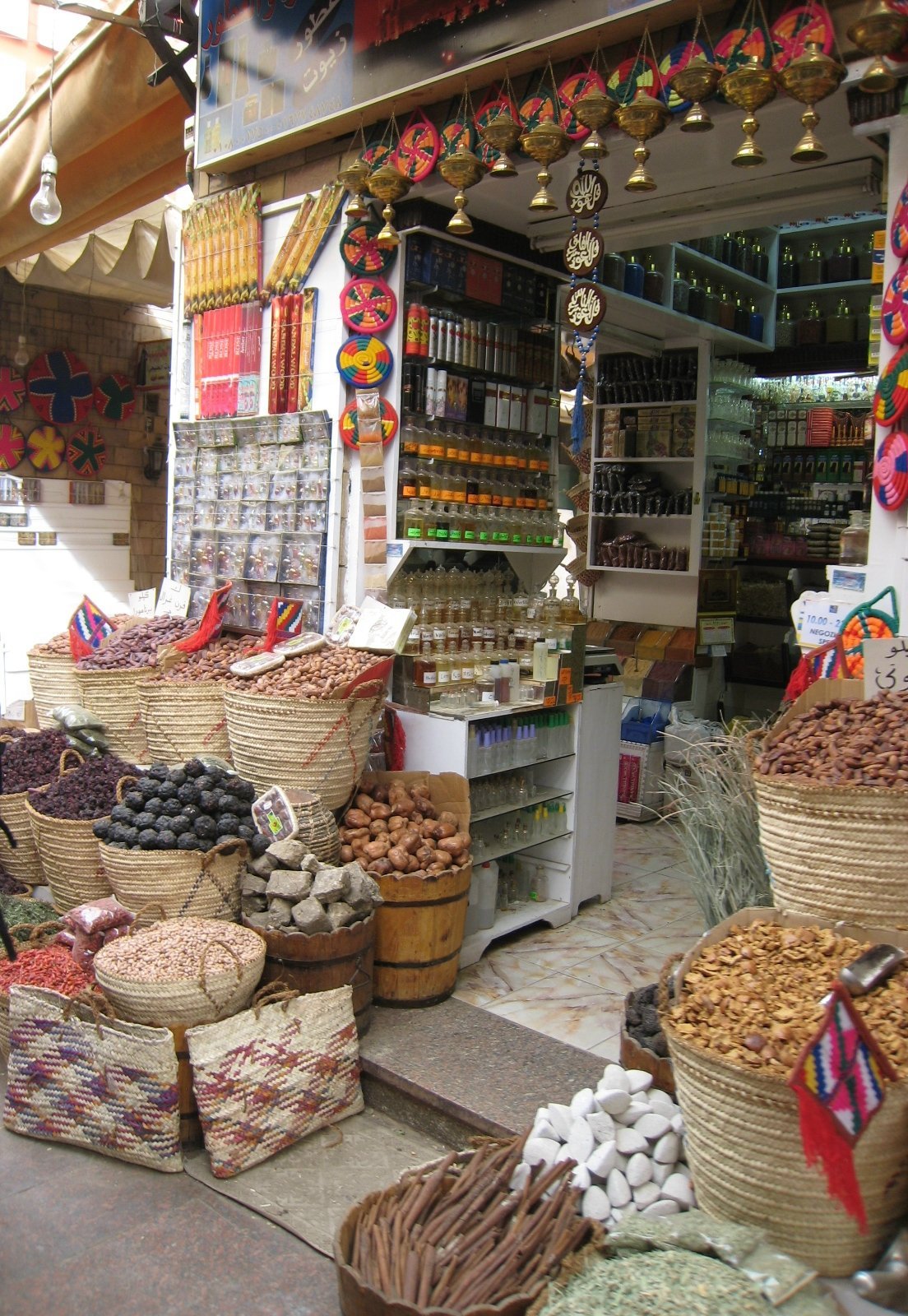
- The spice and perfume lanes. Around Al Muski and the lanes just north of it. Cones of ground hibiscus, cumin and dried limes on one side, rows of glass bottles on the other, oils sold by the small vial and mixed on the counter.
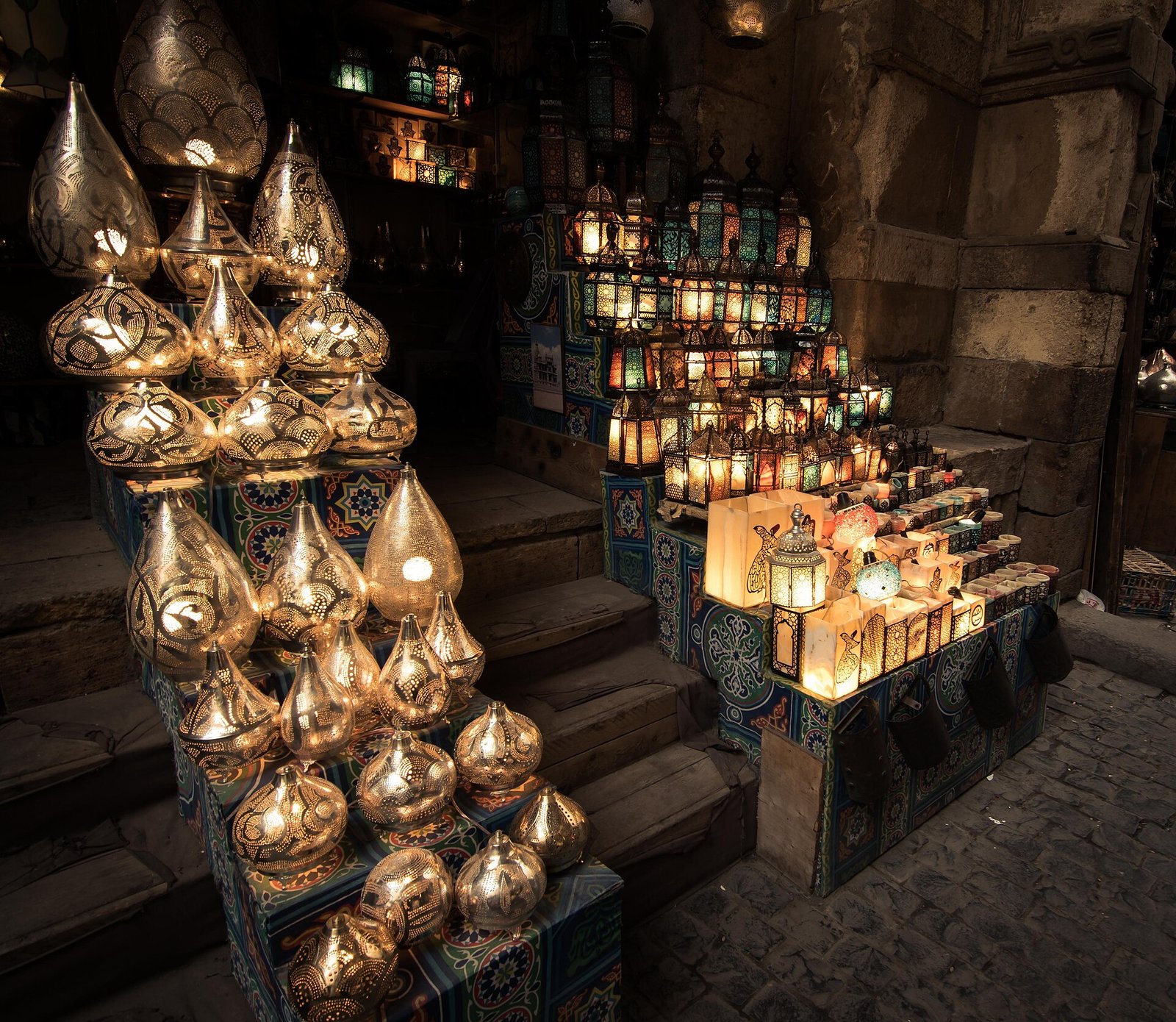
- The copper and lantern workshops. Al Nahhasin, the coppersmiths' stretch of Al Muizz, and the alleys behind the Badestan. Trays and lanterns are beaten and pierced here. You hear the hammering two streets before you see it.
- Al Muski street. The long street running west toward Ataba. Within a few hundred yards it becomes the everyday market of the city: fabric, shoes, housewares and the cheapest spices in the district.
The rule: the closer you are to Al Hussein square, the more the shop is aimed at you. Walk north to the coppersmiths or west down Al Muski and you are shopping where Cairo shops.
What to buy, and what to walk past
The bazaar sells the best crafts in Egypt and the worst souvenirs, often on the same shelf. Buy what is still made in the workshops around you.
Worth buying
- Hand-beaten copper and brass. Trays, coffee pots, pierced lanterns. Look for irregular hammer marks and real weight in the hand. Stamped factory pieces are perfectly uniform and light.
- Inlaid wood with mother of pearl. Boxes and small tables. Hand-set inlay has slightly uneven joints; a printed sheet repeats its pattern exactly.
- Spices and hibiscus. Buy from a shop where locals are queuing. Dried hibiscus for karkade, cumin, coriander, dukkah blends.
- Glass lanterns. The colored glass fanous is the classic Cairo object. Check that the frame is metal, not painted plastic, and have it wrapped for a suitcase.
- Cotton and galabeyas. Good Egyptian cotton has weight and drape. Rub a corner: if it sheds fluff or shines, it is a synthetic blend.
Walk past
- "Papyrus" that cracks. Real papyrus shows crossed strips against the light and bends without breaking. Banana-leaf paper is what most stalls sell.
- "Antique" anything. Genuine antiquities cannot legally leave Egypt, so whatever you are shown is a reproduction. Pay a reproduction price.
- Resin statues sold as alabaster. Alabaster is cool to the touch and translucent at the edge. Resin is warm and dull.
One test covers everything: ask to see three of the same item. If they are identical, it came from a factory. The full list of what earns its suitcase space is in our guide to what to buy in Egypt.
Haggling is a game, and the game has rules
Nobody in Khan el Khalili expects you to pay the first number. It is the opening of a conversation, and played properly it is one of the more enjoyable half hours of your trip.
- Walk first, buy later. Do a full loop before spending anything. You will see the same lantern in six shops, and the spread of opening prices tells you what it really costs.
- Decide what it is worth to you before you speak. Not what it is worth in Cairo, what it is worth in your living room. That is your ceiling, and it is private.
- Counter low, with a smile. Roughly a third of the asking price is a normal first reply, not an insult.
- Meet in the middle, slowly. Each side moves in smaller steps. Silence and a shrug are moves too.
- Walk away once, genuinely. If the price has room, you will be called back within ten steps. If not, the last number was honest and you can return without embarrassment.
- Once you agree, pay. Backing out after a handshake is the one real breach of etiquette.
Bundling items from one shop for a better total is expected. Haggling over a glass of tea is not. Keep it light: raised voices lose every time. The Arabic phrases that change the mood at the counter are in our guide to haggling in Egypt.
El Fishawi and the coffeehouse rule
The landmark inside the bazaar is not a shop. It is El Fishawi, a coffeehouse that has been pouring tea in the same alley off Al Hussein square for more than two centuries, with tarnished mirrors the size of doors, brass lamps, marble tables spilling into the lane and waiters who have seen everything. Naguib Mahfouz, the only Arabic-language writer to win the Nobel Prize for Literature, wrote at these tables and set his Cairo novels in the streets outside.
It is crowded, it is touristy in the evening, and it is still the right place to sit. The coffeehouse rule is this: a stop for tea in Khan el Khalili is not a break from the visit, it is the visit. Order black tea with fresh mint, hot karkade or a shisha with apple tobacco, and stay as long as you like. Nobody will move you along.
Sellers pass the tables with wallets and jasmine necklaces; a polite no shukran works. If El Fishawi is packed, the quieter coffeehouses toward Al Muizz serve the same tea with more room. What to order and how the shisha ritual works is in tea and shisha in Egypt.
Al Hussein square and the mosque
The open square on the east side of the bazaar takes its name from the Al Hussein mosque, founded under the Fatimids in the 1150s and largely rebuilt in the nineteenth century. It holds a shrine that many Egyptians believe contains a relic of Hussein, the grandson of the Prophet, which makes it one of the most venerated places in the country. On religious nights the square fills with families, sweets stalls and Sufi chanting.
The interior is for Muslim worshippers, so as a non-Muslim visitor you admire it from the square. The square itself is the bazaar's living room: cafes around the edge, children with balloons, the evening call to prayer echoing off the minarets, and the easiest meeting point in the district.
Across Al Azhar street, through an underpass, is the Al Azhar mosque and university, founded in the tenth century and still one of the great centers of Islamic learning. Non-Muslims are welcome in its courtyards outside prayer times, with shoulders and knees covered, and it is the natural bookend to the bazaar walk.
The best hours, and the days the bazaar sleeps
| When | What you get | Best for |
|---|---|---|
| Mid-morning | Shutters going up, workshops at it, few visitors | Buying calmly, photos without crowds |
| Early afternoon | Heat in the open lanes | Coffeehouse time |
| Late afternoon into evening | Lamps on, terraces full, the district out walking | The classic first visit |
| Late night | Cafes open, most shops shut | Tea and shisha after dinner |
Late afternoon into the first hour after dark is the answer for a first visit: lanterns lit, workshops still going, terraces filling with Cairenes on their way home. If you are serious about buying, come back in the morning, when sellers have time and you have room to think.
The days it sleeps: a good share of the shops in the bazaar itself take Sunday off, so a Sunday evening feels half shuttered, and Friday is thin until the midday prayer ends. During Ramadan the lanes are quiet by day and at their most alive after the evening meal, late into the night. Check the current pattern with your guide, because it shifts with the season. For how the evening fits with the rest of the city, see Cairo at night.
Safety and hassle, in practical terms
Khan el Khalili is safe the way any crowded market in a big city is safe: violent crime against visitors is very rare, pickpocketing in the crush is the real risk, and what wears people down is the hassle, which is verbal, persistent and almost entirely harmless.
- "Where are you from? Looking is free!" The standard opener, every ten steps. Smile, say la shukran, keep walking. No conversation means no pursuit.
- A friendly stranger offers a special shop or a shortcut. A commission runner; the shop pays him out of your price. Decline.
- Crowd crush in the covered lanes at dusk. Normal, and where pockets get picked. Bag in front, phone zipped, wallet not in the back pocket.
- Cash. Many stalls do not take cards and change is scarce, so carry small bills.
- Splitting up. Signal drops inside the covered lanes. Agree on Al Hussein square as the meeting point.
- Dress. Shoulders and knees covered, as for the mosques next door, and the hassle drops noticeably.
Our broader take on the city, neighborhood by neighborhood, is in is Cairo safe for tourists.
Combining the bazaar with Al Muizz street and Al Azhar
The mistake is to treat the bazaar as a destination in itself. It is one corner of the Fatimid city, and the monuments around it are as good as anything in Cairo outside the Pyramids. Walk them together and a shopping stop becomes the best urban afternoon in Egypt.
- Start at Bab al Futuh and Bab al Nasr. The northern gates of the medieval walls, with a stretch of rampart you can climb for a view down Al Muizz street.
- Walk south along Al Muizz. Pedestrian, restored and lined door to door with Mamluk madrasas, mausoleums, merchants' houses and fountains. The Qalawun complex and the Bayt al Suhaymi house are the ones to step inside.
- Turn into the bazaar at the coppersmiths. Al Nahhasin brings you from the monuments straight into the workshops, the right way round: crafts first, souvenirs last.
- Cross to Al Hussein square for tea. El Fishawi or a quieter neighbor, as the lamps come on.
- Finish at Al Azhar and the Ghuri complex. Through the underpass to the mosque courtyards, then the twin buildings of Sultan al Ghuri, and with light left, on to Bab Zuwayla and the tentmakers' street beyond it.
The loop is about two miles on foot, no hills, three to four hours with the stops. The full walk, building by building, is in our guide to Islamic Cairo.
What a guide changes, and how we build the Islamic Cairo day
You can wander Khan el Khalili alone and enjoy it. What a good local guide changes is not the wandering, it is everything around it.
- The hassle stops. A seller who sees you with an Egyptian guide does not bother, because the guide answers for you.
- You get into the workshops. The coppersmith who lets you watch, the inlay workshop upstairs. These are relationships, not addresses.
- You buy at the right counter. Our guides do not take you to a commission shop. They tell you which lane, which material and which fair range, then leave you to play the game.
- The timing works. Prayer times, the day a shop is shut, the hour the underpass is a river of people: a guide steers around all of it.
Here is how Explora Egipto slots the bazaar into a full day, with our own guide and vehicle. Morning at the Citadel of Saladin and the Sultan Hassan mosque below it, while the light is best on the domes. Lunch in the old city. Early afternoon at Al Azhar, then the walk down Al Muizz from the northern gates, timed so you reach the coppersmiths as the sun softens and the bazaar as the lamps come on. Tea at El Fishawi, and the driver waiting at Al Hussein square when you have had enough.
With two days in Cairo, this is the second afternoon, after the Pyramids and the museum. With one, we compress it to Al Muizz, the bazaar and tea. Both versions are among our Cairo excursions, adjusted to your dates and pace.
Frequently asked questions
Is Khan el Khalili bazaar worth visiting, or is it a tourist trap?
Both, depending on where you stand in it. The covered lanes next to Al Hussein square are the souvenir strip and you can see them in twenty minutes. The goldsmiths' lane, the copper workshops, the spice shops off Al Muski and the coffeehouses are a working market Cairenes still use, and with Al Muizz street they make the best walk in the city. Go for the district, not the stalls.
How much time should I spend at Khan el Khalili?
Ninety minutes covers the lanes and a tea. A half day is right if you combine it with Al Muizz street and Al Azhar, which is what we recommend. Serious shoppers should plan a second short visit in the morning, when the workshops are calm and you can compare without a crowd behind you.
Can I visit Khan el Khalili on my own, without a guide?
Yes, and many people do. Take a ride-hailing car to Al Hussein square, walk in, and use the minarets to reorient when you lose your way, which you will. What you give up is the workshops behind the shop fronts, the context for the monuments and a quieter visit, since sellers work harder on someone who is alone.
What is the best day of the week for the bazaar?
Any day except Sunday, when a good share of the shops in the bazaar itself close, and any time except Friday morning, when the lanes are thin until the midday prayer ends. Monday through Thursday late afternoon is the sweet spot, and Saturday has the most atmosphere, with Cairene families out. Confirm the current pattern with your guide before you fix the day.
Can non-Muslims enter the Al Hussein mosque?
As a rule, no. The Al Hussein mosque holds a shrine of great religious importance and its interior is kept for Muslim worshippers, so plan to see it from the square. Al Azhar mosque across the street is different: non-Muslims are welcome in the courtyards outside prayer times, with shoulders and knees covered and shoes removed.
Should I pay with cash or card in Khan el Khalili?
Cash, in small bills, for almost everything. The larger jewelry shops and the goldsmiths usually take cards, but the stalls, spice shops and coffeehouses are cash only. Bring more small notes than you think you need, because change is scarce, split the cash between two pockets, and change money before you arrive rather than inside the bazaar.
Walk the lanes with someone who knows the coppersmiths by name
Tell us your dates in Cairo, who is traveling and how much time you want in the old city, and we come back with the Islamic Cairo day built around the bazaar at the right hour, with our own guide and driver and no commission shops. Ask us for the quote.